Canada’s AI Strategy: From National Ambition to Practical Adoption
- Chris Dore
- Jun 9
- 5 min read

For years, Canada has been recognized as one of the countries that helped shape modern artificial intelligence. The foundational work of Geoffrey Hinton, Yoshua Bengio, Richard Sutton, and others gave Canada global credibility in AI research.
But research leadership is no longer enough.
The central challenge now is adoption.
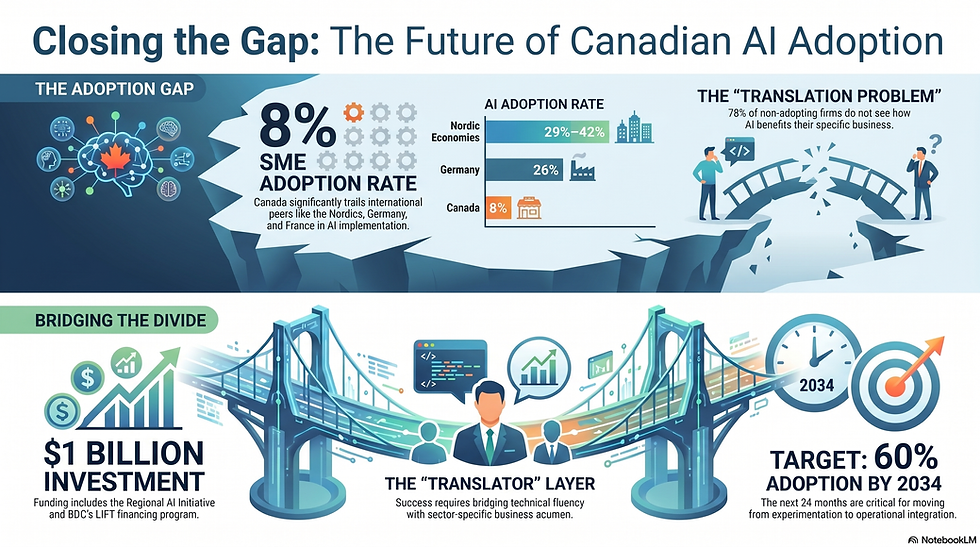
According to the strategy, only 8% of Canadian SMEs have formally adopted AI. That places Canada significantly behind several peer economies, including Nordic countries, Germany, and France. For a country with world-class AI expertise, the gap between invention and implementation is now one of the most important economic issues facing Canadian businesses.
The strategy identifies this challenge clearly. Many organizations are aware of AI, but far fewer understand where it applies, how to implement it responsibly, or how to turn experimentation into measurable business value.
That is not simply a technology problem.
It is a translation problem.
Canada’s AI Adoption Gap
One of the most important findings in the strategy is that 78% of non-adopting firms do not see how AI benefits the goods or services they provide.
This matters because it shifts the conversation.
The issue is not that Canadian businesses are uninterested in AI. It is that many do not yet have a practical, credible path from awareness to implementation.
For small and medium-sized enterprises, the barriers are often specific and operational:
Where does AI apply in our business?
What use cases are worth pursuing first?
What data, systems, and processes need to be in place?
What risks does AI introduce?
How do we train our people?
How do we govern AI responsibly?
How do we move from pilots to actual productivity gains?
The federal strategy responds with meaningful commitments, including a $500 million Regional Artificial Intelligence Initiative, a $500 million LIFT financing program through the Business Development Bank of Canada, and a new AI Literacy and Adoption Assessment tool designed to help SMEs identify use cases and measure readiness.
These are important steps.
But funding and program infrastructure alone will not close the adoption gap.
Canadian businesses also need trusted advisory capacity. They need organizations that can translate AI capability into sector-specific, practical, and responsible implementation plans.
That translation layer will be critical if Canada is going to reach its stated target of 60% business AI adoption by 2034.
AI Literacy Is Strategic Infrastructure
The second major issue is literacy.
Of the six pillars in AI for All, Pillar Two, Empowering Canadians, may have the most immediate consequence for organizations trying to adopt AI today.
Its core message is straightforward: the economic benefits of AI flow through people, not technology.
Adoption without literacy does not produce productivity. It produces confusion, inconsistent use, unmanaged risk, and low trust.
The strategy cites research showing that Canada ranks near the bottom among surveyed countries on AI training, literacy, and public trust. Fewer than one in four Canadians report having received AI training, and fewer than four in ten describe themselves as having moderate or high knowledge of AI tools.
This creates a real organizational challenge.
AI tools are already entering workplaces. Employees are experimenting with them.
Managers are trying to understand their productivity potential. Leaders are being asked to make investment, privacy, governance, and security decisions in a fast-moving environment.
Without literacy, organizations struggle to separate useful applications from hype. They also struggle to manage risk.
The strategy includes several commitments to address this, including a National AI Literacy Initiative targeting one million post-secondary students, training for more than 3,000 educators, investment in K-12 digital skills, and modernization of the Job Bank using AI-powered matching.
These are valuable national initiatives.
Institutional programs matter, but AI is already reshaping workflows inside organizations now. Many businesses cannot wait years for national programming to fully reach them.
Organizations need practical, applied AI training that is specific to their sector, their tools, their workflows, and their risk environment.
AI literacy is no longer only a workforce development issue.
It is a strategic business asset.
Organizations that build internal AI fluency now will compound that advantage over time. Those that wait will find the gap harder to close later.
The Real Test Is Implementation
Canada’s AI for All strategy is ambitious, substantive, and unusually honest about the country’s core AI challenge.
It recognizes that Canada does not simply need more AI research, more pilots, or more public funding.
The strategy gets several things right. It connects trust, opportunity, and sovereignty instead of treating them as separate priorities. It acknowledges that adoption requires translation, not just capital. It identifies healthcare as a mission-driven opportunity, supported by an initial $200 million commitment. It also recognizes that AI sovereignty will require international collaboration, including partnerships such as the Sovereign Technology Alliance with Germany.
These are meaningful signals.
But implementation will determine whether the strategy succeeds.
Three questions deserve close attention.
1. Will SMEs Get the Advisory Support They Need?
Funding helps, but many businesses are not stuck because they lack access to capital.
They are stuck because they do not know where AI applies, what risks it introduces, what systems need to change, or what sequence of actions makes sense.
That is an advisory challenge.
AI adoption requires diagnosis before deployment. Organizations need to understand their readiness, identify high-value use cases, prioritize responsibly, and build a roadmap that connects AI initiatives to business outcomes.
Without that translation layer, funding may accelerate activity without necessarily producing impact.
2. Will Trust Be Operationalized?
The strategy names important risks, including privacy concerns, algorithmic bias, deepfakes, online harms, and security challenges.
Naming those risks is important.
But organizations need practical operating models.
Responsible AI adoption requires more than policy language. It requires privacy reviews, AI use policies, vendor risk assessments, data governance, security controls, employee training, accountability structures, and ongoing monitoring.
This is where AI adoption becomes more than a technology project.
It becomes an organizational governance challenge.
For many Canadian organizations, this will be one of the most important areas of work over the next several years. The businesses that adopt AI responsibly will be those that build privacy, security, and governance into implementation from the beginning.
3. Will Canada Move Fast Enough?
Canada has world-class AI research credibility.
But historical leadership is not a competitive advantage unless it leads to productive deployment.
The next stage of AI leadership will be defined by execution: how quickly businesses adopt, how effectively workers are trained, how responsibly systems are governed, and how well Canadian organizations turn AI capability into durable economic value.
This is the real test.
Announcements matter, but implementation matters more.
What This Means for Canadian Business Leaders
For business leaders, the message is clear: do not wait for the national strategy to arrive at your doorstep.
Start building internal capacity now.
Assess your organization’s AI readiness. Train your teams. Identify high-value use cases. Review privacy and security implications. Establish governance practices. Build a practical roadmap that connects AI adoption to measurable business outcomes.
The organizations that move from experimentation to integration over the next 24 months will be better positioned than those still waiting for certainty.
Canada’s AI for All strategy provides an important national framework.
But the work of adoption will happen organization by organization, team by team, process by process.
That is where strategy becomes capability.
And that is where AI becomes advantage.
How ScarlettNova Can Help
ScarlettNova supports Canadian organizations with AI strategy, readiness assessment, adoption planning, AI literacy, workforce training, governance, privacy, security, and responsible implementation.
We help organizations move from AI interest to AI action, with practical support designed for real business environments.
To learn more, visit ScarlettNova at:
You can also follow ScarlettNova on LinkedIn for ongoing insights on AI strategy, adoption, governance, and responsible implementation: