What the OECD’s New SME AI Report Means for Small Businesses—And Where to Start
- Julie Lavergne
- Jan 7
- 5 min read
Updated: Jan 12

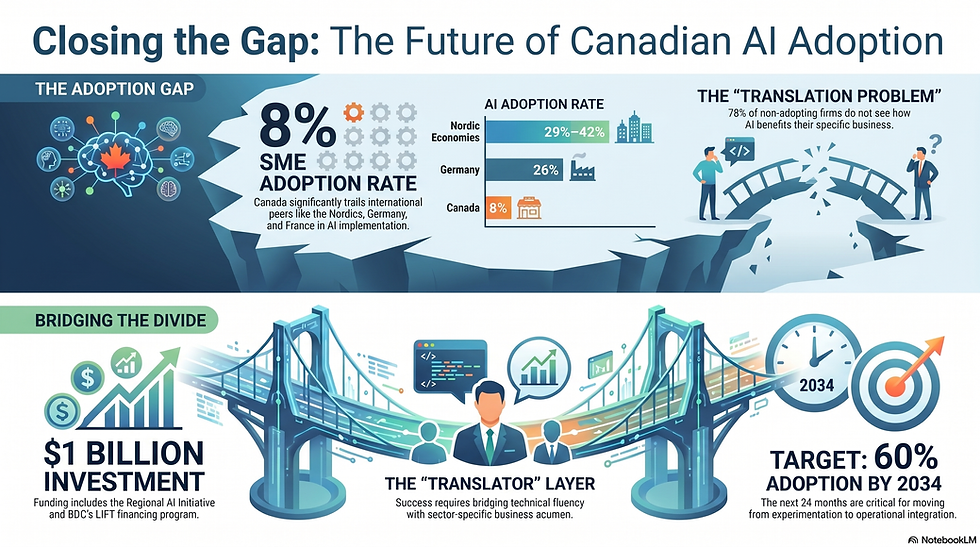
The OECD just released one of the most comprehensive reports, to date on how small and medium-sized businesses (SMEs) are adopting AI and why many are still struggling.
As a consulting firm that helps SMEs adopt AI responsibly and effectively, we didn't just skim the summary.
We read the full 60-page document so you don't have to, because we recognized our own clients' challenges reflected in its data.
Here’s what matters most for business owners, operators, and leadership teams who want to use AI to reduce workload, improve productivity, and truly future-proof their business.
1. AI Adoption Is Rising Fast—But SMEs Are Being Left Behind
Across OECD countries, AI use by businesses more than doubled in four years. But the gap between small and large companies is widening and this should be a serious wake-up call:
40% of large firms use AI.
Only 11.9% of small firms do.
That gap exists across every type of AI from text generation to robotics. And when SMEs do use AI, it’s usually for small peripheral tasks, not the core work that drives revenue.
Our take: SMEs are experimenting but they are missing the chance for transformation. The competition isn't waiting for you to catch up. Our clients are forward thinkers, experimenters and ready to start, even small, taking steps towards AI Adoption.
2. The Productivity Upside Is Real (and Proven)
The report is clear: firms that adopt AI are definitively more productive, even when you compare companies of similar size and sector.
Economists estimate that AI could add 0.2–1.3 percentage points to annual productivity growth across G7 economies a shift comparable to the gains seen during the internet boom.
The irony? Most SMEs aren’t capturing that potential. They are being held back not by the complexity of AI, but by predictable, solvable, foundational challenges.
The good news is that these barriers are precisely what we can fix. The report identifies four common obstacles that, once addressed, unlock real-world productivity gains.
3. The Barriers Are Predictable…. and Solvable
The OECD identifies four big obstacles that slow or stop AI adoption. For us, these aren't just obstacles—they are the four areas we target in every client audit:
Barrier #1: Connectivity
The Problem: Some SMEs still don’t have high-speed, reliable broadband. AI tools—especially cloud-based ones—depend on it.
The Fix: If your foundation is cracked, your AI systems will fail. This is the simplest fix with the highest ROI on your overall tech stack.
Barrier #2: Skills
The Problem: SMEs consistently report digital and AI skill shortages as their #1 barrier.
The Fix: You don’t need data scientists. You need confident users. AI literacy training is non-negotiable for leadership and staff.
Barrier #3: Data & Tools
The Problem: Many SMEs don’t know where their data lives, how to prepare it, or how to connect systems that were never designed to talk to each other.
The Fix: Stop buying new tools. Get your existing systems talking. We focus on cleaning and connecting data first; AI is simply the automation layer on top.
Barrier #4: Financing
The Problem: AI adoption requires time, experimentation, and sometimes external expertise. SMEs often lack the budget or confidence to invest.
The Fix: The focus should be on "quick wins." Target a project that saves 10 hours a week or closes 1 extra lead a month. This generates instant ROI to fund the next step.
4. A Useful New Framework: The Four Types of SME AI Adopters
The OECD introduces a taxonomy that we have long used to benchmark our clients' progress it's the quickest way to identify your next best move:
AI Adopter Type | Description | Our Perspective |
AI Novices | Basic experimentation; using AI in isolated tasks. | You’re testing the waters. Great for building literacy, but dangerous if you stop here. |
AI Explorers | Customising small models or using AI for specific functions. | You have a clear use case (e.g., marketing AI). This is where productivity starts to show up. |
AI Optimisers | Multiple AI tools/ agents working across teams; productivity begins to scale. | The goal state for immediate transformation. AI is part of your operational SOPs. |
AI Champions | AI is embedded across the business—operations, decisions, customer experience. | Fully future-proofed and highly competitive. AI drives the core business model. |
Most SMEs today fall into the first two categories. The biggest, most defensible leaps in productivity and margin come when businesses progress from Explorer → Optimiser.
5. So What Should SMEs Do Next? (Based on the Report + Our Field Experience)
This is the simplest version of an AI roadmap aligned with the OECD’s findings and proven to work for our clients.
Step 1: Identify your starting point.
Are you a Novice, Explorer, Optimiser, or Champion? This determines your next move and stops you from wasting time and budget. We can help with our AI Assessment, a quick survey providing the baseline you are working with.
Step 2: Start with the business problem—not the tool.
The report repeatedly shows that productivity gains come from solving operational bottlenecks, not playing with AI features. Don't search for an AI tool; search for a repetitive, expensive process you want to eliminate.
Step 3: Strengthen your digital foundations.
Clean data, consistent workflows, good connectivity, and cloud-based tools. AI will amplify whatever foundation you already have; good or bad. We find that most businesses skip this step and pay for it later.
This may sound long and tedious, but can be tackled in a layered iterative approach. You don't need perfection before you start; you need a strategic plan to improve the foundation piece-by-piece as you implement AI. This ensures that every system you build is sustainable.
Step 4: Build AI literacy across the team.
You don’t need data scientists, you need experimenters, adopters who understand the output and the ethical guardrails. Small, targeted training can unlock big gains and massively reduce risk.
Identify your internal champions, who can lead the adoption effort within your company and sustain the momentum long after our engagement is complete. The goal is internal independence, not dependency.
Step 5: Pilot, measure, scale.
The OECD notes that productivity gains often lag because organizations don’t properly integrate AI into existing processes. A pilot is worthless if it doesn't become a Standard Operating Procedure (SOP). Pilot → SOP → measure → expand.
6. The Bottom Line for SMEs
AI is no longer a “big-company technology.” It is now an essential utility for modern businesses. We say “every company is a technology company”
Every example in the OECD case studies shows how small businesses from bakeries to biotech are already benefiting from AI for marketing, customer service, efficiency, and product innovation.
But the real differentiator isn’t the tool it’s whether a business builds the systems, skills, and confidence to use AI strategically.
If you’re still waiting for the right moment, you're already losing ground.
If you want help understanding where your business fits in the AI adoption taxonomy or how to design your first (or next) ROI-focused AI workflow, we can help.
Our consulting practice is built specifically for SMEs looking for practical, affordable, responsible AI adoption that moves you from Experimenter to Optimiser in record time.
Julia Lavergne, Chief Strategy Officer